MANUFACTURING
OVERVIEW
Located in Cape Town, South Africa, Robertson and Caine currently manufacture 3 sailing catamarans and 3 power catamarans for the world markets. Ranging in size from 40-53ft.
Manufactured to standards beyond certification, our products are developed and tested off the Cape of Storms at the tip of Africa in the toughest ocean conditions.We strive to be the benchmark for ocean cruising catamarans. Through innovative design, development of new materials and processes, handcrafted skills and strict quality standards.
R&C continues to position itself as a world-class manufacturer with the objective to deliver quality products throughout the world.
All of our boats are built in accordance with ISO standards and are certified by the International Marine Certification Institute (IMCI) in accordance with the Recreational Craft Directive 2013/53/EU. Additionally, our product is also certified by the National Marine Manufacturers Association (NMMA) to ABYC standards. We are members of the American Boat and Yacht Council (ABYC) and the National Marine Manufacturers Association (NMMA).

With plants covering over 85 000 sqm, manufacturing a range of six models by a Team of 2400+ persons, Robertson and Caine is focused upon producing world-class catamarans of exceptional build quality. Adhering to sustainable and safe production practices.


DESIGN
Our design philosophy is integration simplified. We blend the ease of boat handling with effective boat speed, without compromising onboard comfort and functionality. Our inhouse design Teams in Tampa and Cape Town, constantly innovate form and function, producing award winning industry benchmark catamarans in power and sail.

Production
To build for solid blue water performance, Robertson and Caine use superior materials, fit for purpose, with every step of the build process, adhering to global standards and subject to stringent quality control. Robertson and Caine catamarans dominate the charter fleets of The Mooring and Sunsail, thus are built to be reliable, with low maintenance.
The construction of these vessels incorporates various manufacturing processes such as Hand Laminating, Vacuum Infusion as well as Resin Transfer Moulding to build the required composite parts. For structural parts, multiaxial E-Glass is used in combination with PVC Foam Core within vacuum infusion processes to provide rigidity, impact resistant and buoyant vessels.
Isophthalic/Vinyl Ester resins and NPG gelcoats prevents the onset of hydrolysis. The strong hull laminate is light and durable resulting in a dynamic weight-carrying capacity and excellent motion reaction.
Manufacturing techniques such as vacuum infusion, RTM Light, air demoulding and full deck/hull infusion are used to build a lighter, sturdier product, with greater performance potential.
Each of our six models has their own dedicated production facilities from moulding to final assembly. These are served by a joinery manufacturing facility and a distribution centre. Three catamarans are launched weekly. The catamarans are then shipped globally, with the mast already stepped, through the Port of Cape Town on transport vessels.


5-axis CNC Machining
5-Axis machining involves using a CNC system to move the table/bed and cutting tool along five different axes simultaneously. This enables the machining of very complex parts, which is why 5-axis is especially popular for marine applications.
All the machining and milling is done on advanced styling and tooling base materials with precision robotic systems ensuring perfect accuracy each and every time.

Hand Built Plugs
Following the precise assembly of CNC-machined timber profiles, our highly skilled craftsmen begin the critical process of plug cladding. This stage requires a combination of technical expertise, meticulous attention to detail, and years of hands-on experience to ensure the plug accurately reflects the intended design geometry.
Each step of the process is closely monitored by a team of Composite Engineers and tooling experts, who ensure dimensional accuracy, structural integrity, surface consistency, together with QC compliance.
Class "A" finishing achieved, the plug serves as the master pattern from which new production moulds can be developed.

Deck & Hull Infusion
The resin-infused Deck & Hull laminate is strong, light and durable resulting in a dynamic weight-carrying capacity and excellent motion reaction.

Foam Cores
High-density PVC foam cores are extensively used throughout all the resin-infused parts. The cores are all CNC cut and nested to precise dimensions as per the engineering drawings.

Advanced Fabrics
Multiaxial E-glass stitched fabrics ensure maximum strength and promote a very high calibre glass-to-resin ratios. These fabrics includes, but are not limited to, unidirectional, biaxial and quadraxial E-glass.

Collision Bulkheads
In case of hull damage, watertight collision bulkheads at bow and stern prevent water from entering the hull.

Internal Modules
Internal modules are assembled offline which in turn allows for ease of production as well as enhanced quality control, before final fitment.

Osmosis
NPG gelcoats and a Vinyl Ester resins are used for underwater applications to ensure a resin-rich E-glass barrier layer is achieved which improves resistance to hydrolysis and helps prevent osmosis.

Light Resin Transfer Moulding
Automated moulding processes are used to allow for repeatability at the same weight & quality every time.
At Robertson & Caine, we systematically evaluate the quality of our products at every manufacturing stage to ensure that quality standards are met.
Robertson and Caine’s production standards of precision, innovation, and quality come together to shape the foundation of every catamaran we manufacture.
We enhance global standards and certification with our own stringent Robertson and Caine quality standards. Quality processes ensure our foundation composite components are designed, engineered and manufactured to high performance standards and durability. Through continuous exploration of new materials, manufacturing techniques, and production process methodologies, we remain at the forefront of composite technology, industry-wide and drive innovation across our award winning catamarans. Close collaboration with Engineering, Production and Quality teams, translate feedback and concepts, into practical, measurable enhancements that elevate both product performance and manufacturing efficiency.

Hull Mold Preparation
On the manufacturing floor our team of experienced Quality Control (QC) Inspectors begin their inspections during hull mold preparation, ensuring each mold is free of contaminants, prior to gelcoat application.
QC Inspectors verify that mixing ratios and temperatures align with R&C standards operating charts and once the gelcoat cures, it undergoes a comprehensive inspection to ensure that it meets global and certification quality standards.
Dry Loading Infusion
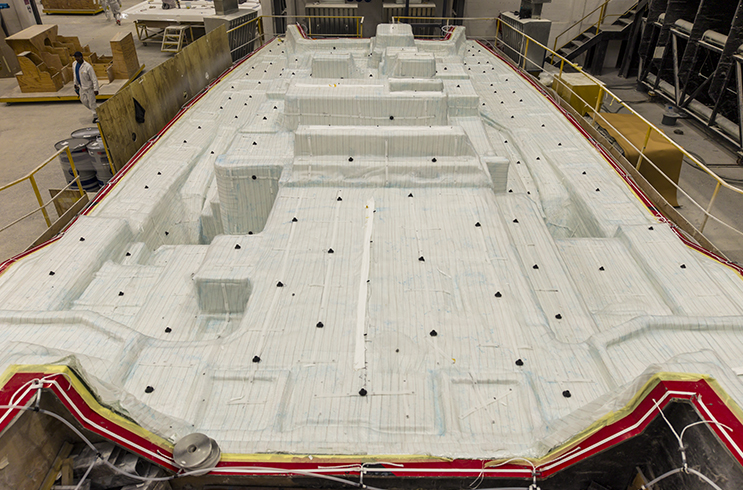
During the dry loading phase for infusion, material layers are checked against a laminate schedule with technical oversight of our composite engineers. Before resin infusion, QC Inspectors verify that the vacuum bag maintain the specified vacuum infusion pressure to ensure vacuum integrity while infusing. Vacuum integrity is verified with digital leak detector technology using a combination of camera and sound sensors to proactively identify vacuum leaks before the infusion process begins. This attention to the smallest detail, contributes to enhanced overall infusion quality, eliminating potential downstream hull quality issues. QC protocols ensure manufacturing processes are maintained at each stage.
Wet Loading Infusion
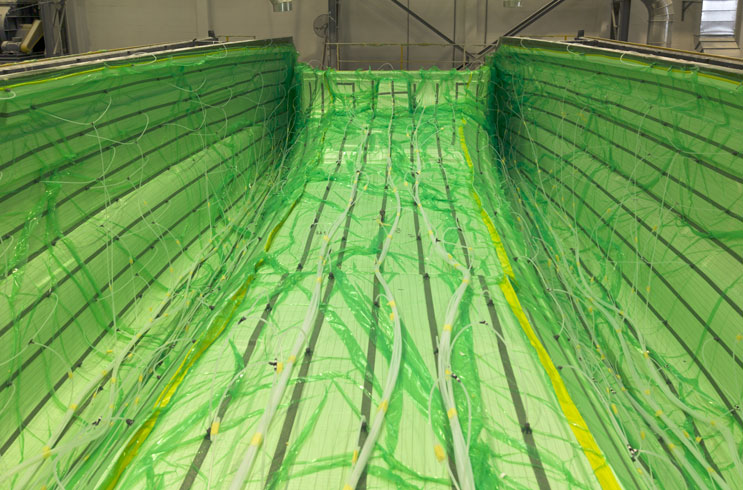
Technology replaces traditional during the infusion process, with our resin mixing and dispensing, driven by resin mixing technologies. Allowing for consistent resin quality through precise ratio control and direct injection into the hull mold.
This integrated process is inline both with quality control and supports a more sustainable manufacturing approach. Long term relationships with our material suppliers has overtime, developed our own unique resin formulations, aligned with our build process and environment.

Single-Shot Infusion
We blend new techniques with traditional boat building mindsets for structural integrity and safety. Implemented into the build of our latest models is “single-shot infusion” of the hull, a game changer in structural integrity quality. This is accompanied with the application of composite materials such as unidirectional fibreglass, innovative design techniques and build application, results in improved structural integrity and manufacturing efficiency. Removing the manufactured hull from the Mold is a synchronised ballet that presents a completed hull and opens up the hull Mold, ready to start the dance again. The newborn hull is subject to a series of visual and acoustic QC checks before approval is granted for the hull to join the assembly line and become a finished Robertson and Caine catamaran.
JOINERY
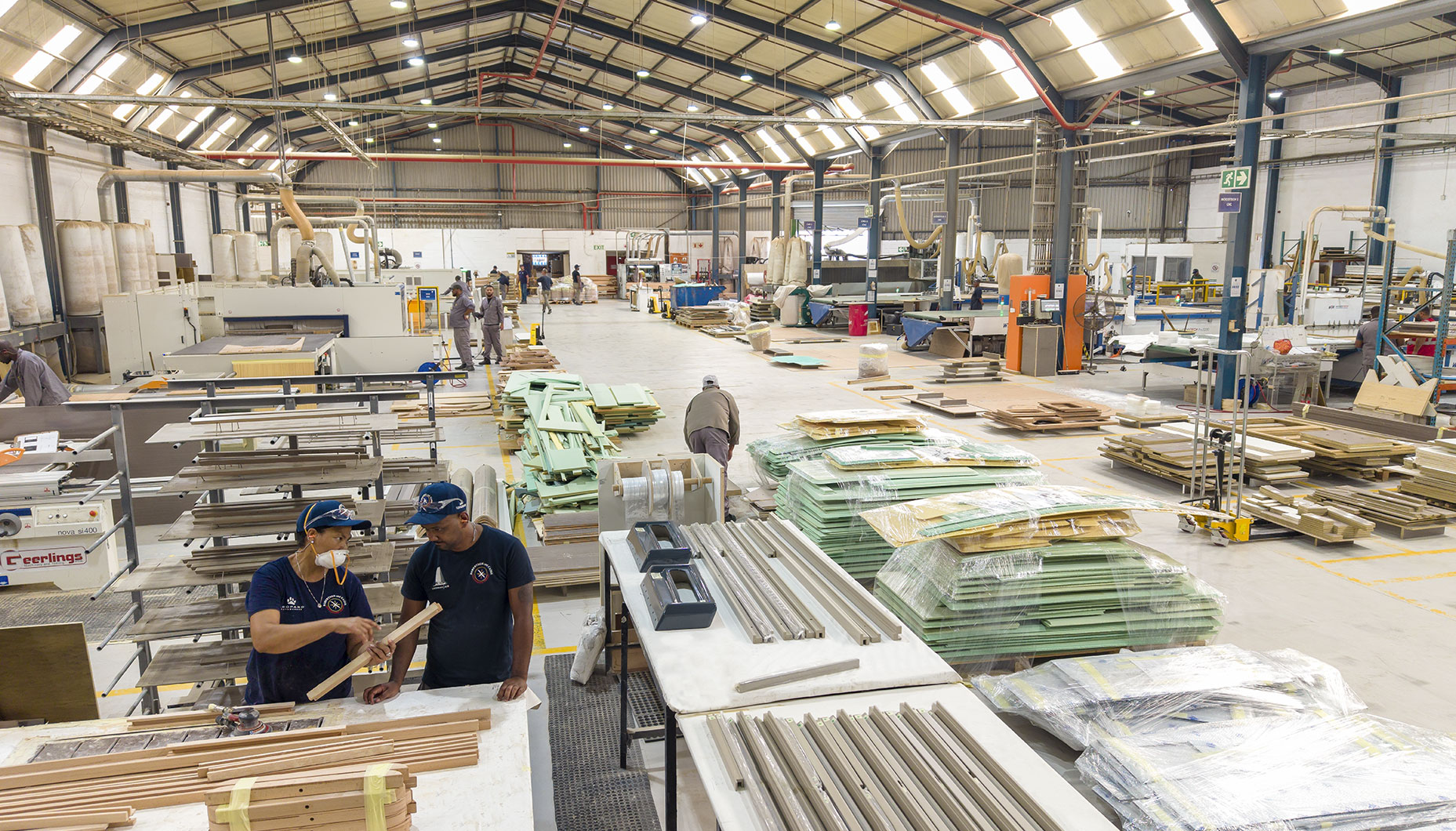
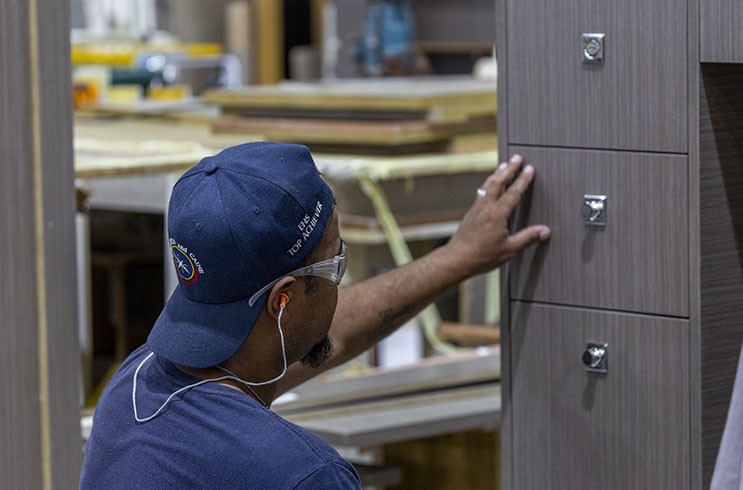
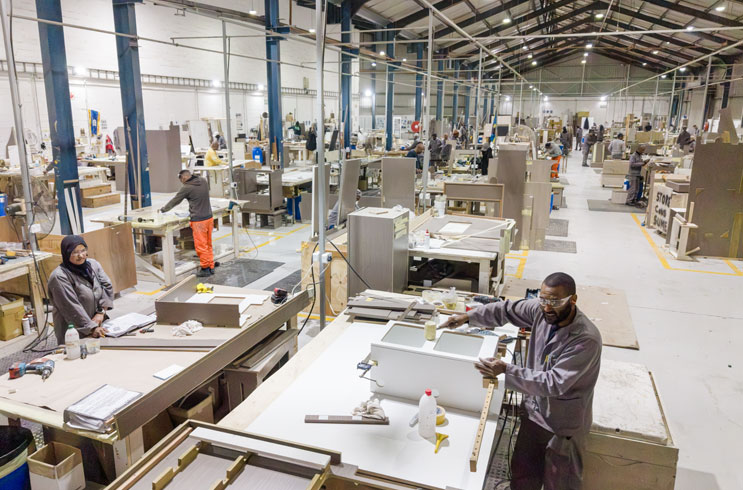
Cape craftsmen and women evolve specialised materials into elegant, contemporarily designed yacht interiors, using a blend of technology, automation and patient handwork.
Seven departments integrate seamlessly to produce components for all six catamaran assembly lines. The Press Shop upgrades various materials to Robertson & Caine's interior quality specifications.
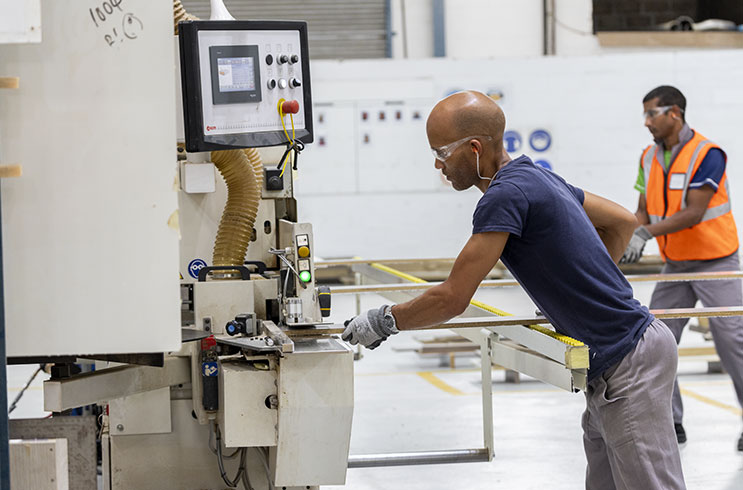
The Machine Shop uses high-tech CNC beam and panel saw automation to precision-cut, shape and end-grain seal materials.
The Spray Shop and Joinery Assembly then take over, with a team of carpenters preassembling components.
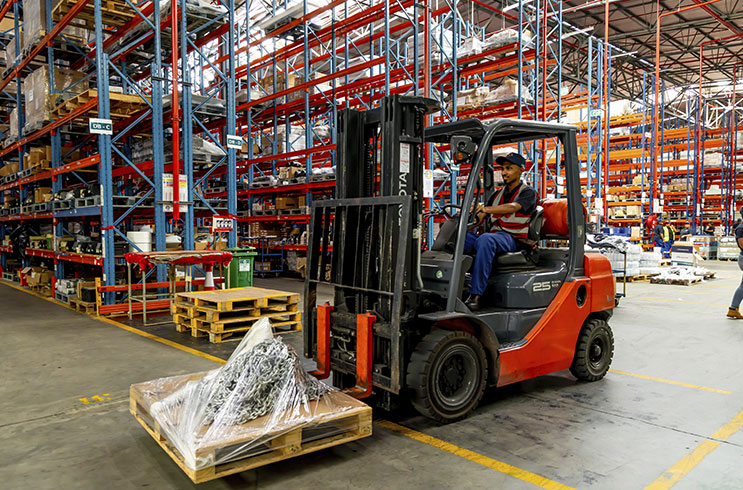
Stores maintains stock of over 12,000 different components, distributed on demand by Dispatch, while the Upholstery Shop manufactures exterior seating for all six lines.